


 English
  中文简体
中文简体 
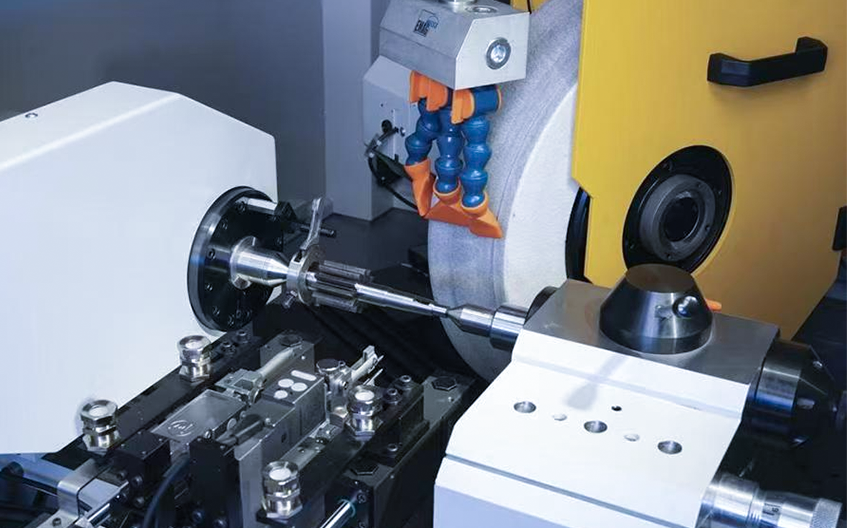
Cylindrical Grinding Machine
Simply put, the working principle of a cylindrical grinder is similar to that of turning outer circles on a lathe. The difference is that a lathe uses a turning tool for cutting, while a cylindrical grinder adopts a high-speed rotating grinding wheel for grinding, delivering far higher machining precision than ordinary lathes.
Working Principle
- The headstock drives the workpiece to rotate at a constant speed.
- The grinding wheel runs at high speed to perform micro-fine cutting on the workpiece surface.
- The worktable drives the workpiece to move back and forth to finish grinding the entire outer circle.
Plain Cylindrical Grinder: Workpiece supported by centers, worktable reciprocates, grinding wheel feeds transversely. Suitable for general shaft parts such as motor shafts and transmission shafts.
Universal Cylindrical Grinder: Equipped with an internal grinding mechanism, capable of machining tapered workpieces. Applied to shafts requiring integrated internal and external circle machining and tapered shafts.
CNC Cylindrical Grinder: Controlled by a CNC system, supports multi-axis linkage, automatic wheel dressing, and precision compensation. Ideal for high-precision, special-shaped shafts and mass production of standard shafts.
Face and Cylindrical Grinder: Grinds the outer circle and the workpiece end face simultaneously. Used for step shafts, gear shafts, and other parts requiring verticality between the end face and outer circle.
Core Advantages: Key Benefits
-
01
Ultra-high Machining Precision for High-end Precision Requirements
Cylindrical grinders are high-precision processing equipment for shaft parts, capable of micron-level fine machining. Its roundness reaches 0.001mm, dimensional tolerance is controlled within ±0.002mm, and surface roughness can achieve mirror-level Ra 0.02μm. It is ideal for machining high-precision components such as precision spindles, lead screws, and aerospace parts. -
02
Strong Compatibility for Diverse Workpieces
This machine features a wide processing range. With different operation methods and special fixtures, it can process stepped shafts, tapered parts, eccentric shafts, and workpiece end faces. Universal cylindrical grinders are also available for inner hole grinding, easily meeting the processing demands of various special-shaped shaft workpieces. -
03
Stable Positioning Datum with Superior Concentricity
Adopting center hole tip positioning, it effectively ensures the concentricity between the workpiece outer circle and the center holes. The unified positioning datum remains unchanged after repeated clamping, which suits multi-process continuous machining. This positioning advantage cannot be matched by centerless grinders. -
04
CNC Intelligent Upgrade Greatly Enhances Processing Capacity
CNC cylindrical grinders are fully functionally upgraded. They realize follow-up grinding of complex profiles like camshafts and crankshafts, and support automatic wheel dressing and wear compensation. Workpiece types can be switched rapidly by changing programs, perfectly fitting flexible mass production.
Selection & Applications: Is It Right for You?
Typical Machined Parts by Industry
Precision Machinery: Machine tool spindles, ball screws, linear guides
Automobile Manufacturing: Crankshafts, camshafts, gearbox shafts, gear shafts
Aerospace: Landing gear components, engine drive shafts, high-precision bushes
Mold Industry: Mold cores, ejector pins, guide pins
Hydraulic & Pneumatic: Piston rods, hydraulic valve spools
Core Points for Grinder Selection
1. Selection by Workpiece Shape
Workpieces with steps, tapers, and end face grinding requirements: Choose cylindrical grinders
Simple, plain shafts without center holes: Prioritize centerless grinders for higher efficiency
2. Selection by Machining Precision
High precision requirement: Roundness < 0.002mm, surface roughness Ra < 0.2μm, adopt precision cylindrical grinders
General precision requirement: Ordinary cylindrical grinders are sufficient
3. Selection by Production Batch
Single piece, small batch & diversified production: Manual / CNC cylindrical grinders are applicable
Mass standardized production: Prefer centerless grinders or special-purpose cylindrical grinders
4. Selection by Grinding Function
Need both external and internal cylindrical grinding: Select universal cylindrical grinders
Only external cylindrical grinding required: Use ordinary cylindrical grinders
Don't hesitate to contact when you need us!

Since its establishment in 1990, the company has 35 years of history.
- Products
- CNC Precision Machined Automotive Parts
- CNC Precision Machined Liquid Cooling Parts
- CNC Precision Machined Power Tool Parts
- CNC Precision Machined Optical Components
- Customize
- Swiss Turning
- Machining Center
- CNC Milling&Turning
- Centerless Grinding Machine
- Cylindrical Grinding Machine
- Contact
-
-
TEL: +86-0574-62480516

-
E-mail: [email protected]

-
Phone: +86-13175199595

-
Address: Address: No. 6 Shiji 1st Road, Mazhu Doumen Development Zone, Yuyao City, Zhejiang Province, China

-
Copyright ©
Xierge Precision Machinery Co.,Ltd.
All rights reserved.
Custom Swiss Precision CNC Machining Parts Manufacturers

