


 English
  中文简体
中文简体 
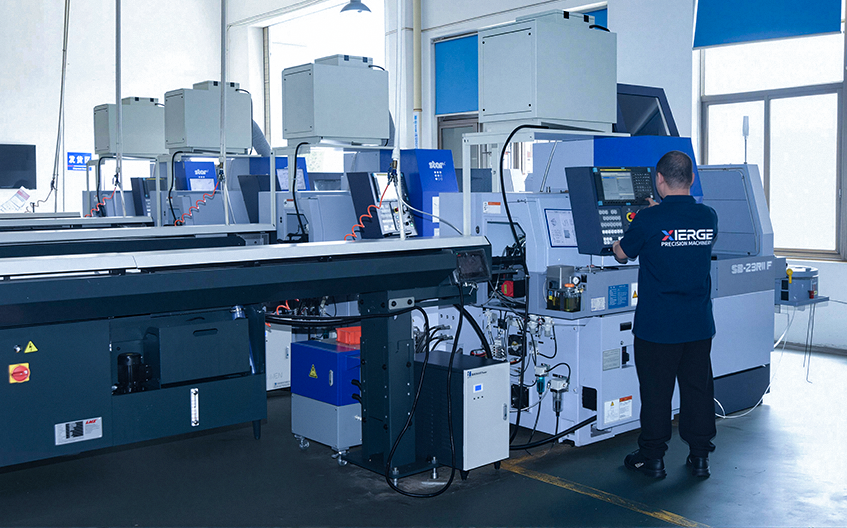
A Swiss-type lathe, also known as a Swiss automatic lathe or sliding headstock lathe, is a CNC machine designed for high-efficiency, high-precision machining of small, slender, and complex shaft-type parts. You can think of it as a miniature "manufacturing plant" that can turn a metal bar directly into a fully finished precision component, such as a bone screw, a connector pin, or a micro gear for a drone.
Its most distinctive feature is that the machining process is the opposite of a conventional lathe. During operation, the bar stock moves axially through a guide bushing — much like blood being pumped by a heart — while cutting tools perform the machining. This is why it's often called a "swiss-type" or "sliding headstock" lathe.
-
01
Complete Machining in One Setup (Done-in-One)
This is its most outstanding benefit. One machine, one clamping operation, and all complex processes (turning, milling, drilling, tapping, etc.) are completed. This eliminates the need to transfer parts between different machines, drastically improving production efficiency. It also removes multiple clamping errors, ensuring superior accuracy and consistency. -
02
Exceptional Precision with "Skin-to-Skin" Support
Swiss-type lathes feature a guide bushing that tightly supports the bar stock immediately behind the cutting point. This "skin-to-skin" support provides maximum rigidity, minimizes deflection, and allows for stable, high-precision cutting. It easily achieves micron-level accuracy (0.001 mm) with excellent roundness and tight tolerances. -
03
Automation for Lower Costs & Higher Output
When paired with an automatic bar feeder, the machine can run unattended — even in "lights-out" manufacturing. A single long bar can be fed automatically to produce hundreds or thousands of parts continuously. Compared to traditional gang-tool lathes, Swiss-type machines can increase efficiency by over 25% while reducing production costs by 20–30%. -
04
Complex Geometries with No Dead Corners
Modern Swiss-type lathes are typically equipped with dual spindles (main and sub-spindle) and numerous live tooling stations. The main and sub-spindles can work synchronously, even machining both ends of a part simultaneously. Whether it's external turning, internal boring, side milling, cross-drilling, or thread tapping, all operations can be handled on a single machine — ideal for complex, non-cylindrical parts.
What's best for:
Typical parts: Slender shafts, precision connectors, medical devices (e.g., orthopedic implants, surgical instruments), 3C electronics (e.g., Type-C metal housings, phone screws), automotive precision valve cores and drivetrain components, aerospace precision parts, and more.
Batch size: High-volume production. Once programmed, the automated process delivers significant cost advantages.
Key selection criteria:
Machining diameter: This is the primary specification. Most Swiss-type lathes handle bar diameters of 20mm, 32mm, or 38mm. Your part dimensions must fall within this range.
Raw material requirements: Because the bar must pass through a precision guide bushing and spindle, the raw material requires good roundness and straightness. Not any bar stock can be used directly.
Guide bushing mode: To maximize material utilization and reduce remnant waste, many modern machines offer a non-guide-bushing (guide-bushing-less) option. Consider this based on your cost priorities.

- Products
- CNC Precision Machined Automotive Parts
- CNC Precision Machined Liquid Cooling Parts
- CNC Precision Machined Power Tool Parts
- CNC Precision Machined Optical Components
- Customize
- Swiss Turning
- Machining Center
- CNC Milling&Turning
- Centerless Grinding Machine
- Cylindrical Grinding Machine
- Contact
-
-
TEL: +86-0574-62480516

-
E-mail: [email protected]

-
Phone: +86-13175199595

-
Address: Address: No. 6 Shiji 1st Road, Mazhu Doumen Development Zone, Yuyao City, Zhejiang Province, China

-

