


 English
  中文简体
中文简体 
CNC Precision Machined Power Tool Parts | Swiss-Type Turning & OEM Custom
Content
When a power tool design moves from prototype to production, the parts that typically cause trouble are the small rotary and housing components: motor shafts, transmission shafts, spline shafts, valve sleeves, and housings that need to hold a tight tolerance across a long run. The sourcing question is not whether a supplier can machine one sample, but whether the same CNC machine, material, and grinding process can deliver the same dimensions on the 5,000th piece. That is where CNC precision machined power tool parts matter, and it is why we have built our production line around Swiss-type longitudinal turning, CNC milling, centerless grinding, and cylindrical grinding, backed by imported inspection equipment.
What Precision Means on Power Tool Components
For power tool components, precision is not an abstract number. It is the difference between a shaft that runs smoothly at 20,000 RPM and one that creates vibration, bearing wear, or a shorter tool life. The practical tolerances on these parts often include diameters of ±0.005 mm, roundness within a few microns, and surface roughness Ra values in the 0.2 to 0.8 µm range. The same applies to concentricity between a ground journal and a milled feature.
Each power tool part has a specific machining requirement. A slender shaft with a high length-to-diameter ratio is best made on a Swiss-type lathe, because the guide bushing supports the material close to the cutting point and reduces deflection. A housing or valve sleeve with cross-drilled holes and flat faces needs a machining center or a turning center with driven tooling. A bearing seat, like a bearing ring or a spline shaft diameter, usually needs centerless or cylindrical grinding after turning to achieve the final diameter, roundness, and surface finish.
The hardest features to hold are often the transitions between drilled holes, milled flats, and ground diameters. A part that is turned in one setup and milled in another can drift in position. By planning operations around a clear datum, we keep the relationships stable.
Materials That Change the Machining Plan
Material also changes the strategy. Stainless steel and bearing steel are common for shafts and sleeves, while aluminum and brass show up in housings and electrical parts. Each material has different chip behavior, cutting speeds, and heat treatment requirements, so a reliable supplier needs to adjust feeds, speeds, and tooling accordingly.
Power Tool Parts We Manufacture
Our standard range includes many parts that appear inside power tools and their drive assemblies. The parts below are typical examples, and we can also machine custom drawings that do not fit into a fixed catalog.
- CNC motor shafts and transmission shafts
- High-speed shafts, slender shafts, and spline shafts
- Planetary gear shafts and precision gear shafts
- Valve sleeves, solenoid valve sleeves, and base housing components
- Plungers, push rods, locating pins, and timing pulleys
For both prototypes and production runs, we can work from bar stock or pre-forged blanks depending on the part size and the required feed rate. For a broader view of the parts we make for this industry, see our CNC power tool components page. If you need a part that is not listed, our CNC precision machined power tool parts line is the right starting point because it combines experience, process planning, and inspection under one roof.
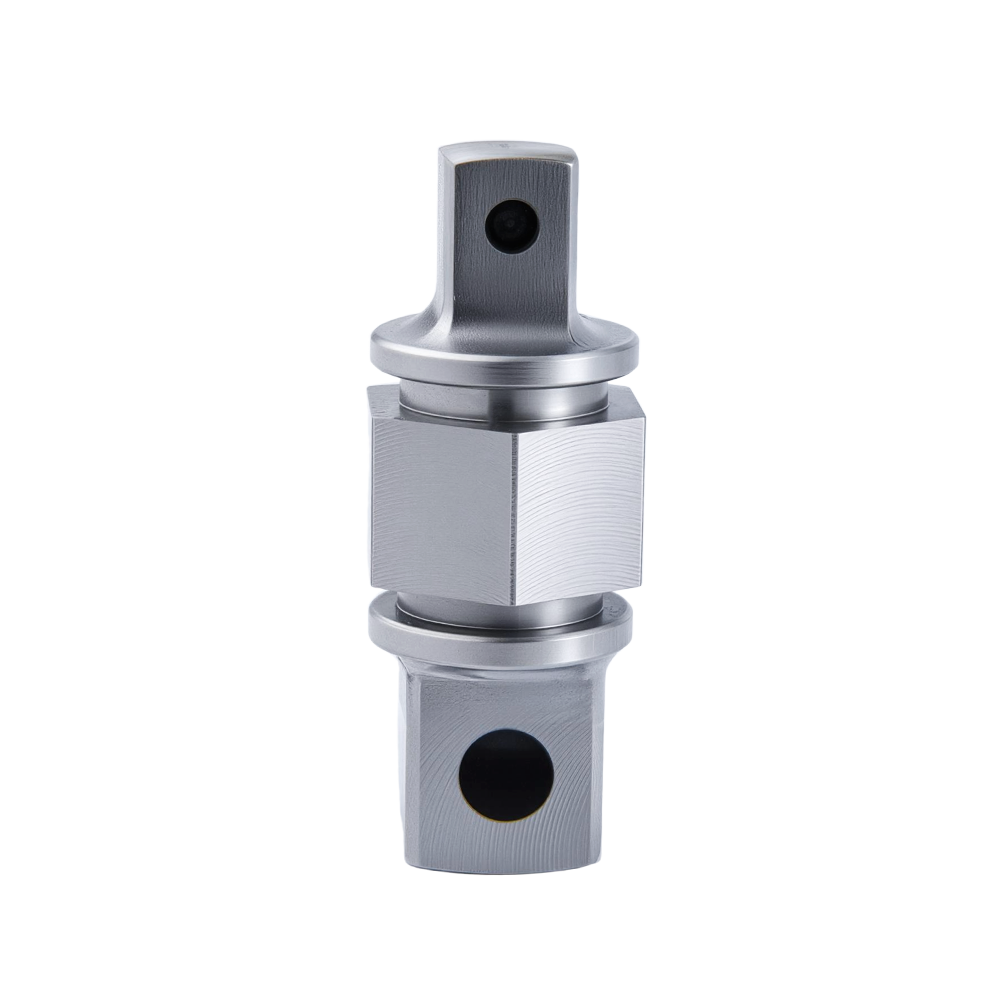 Precision CNC Machined Power Tool ComponentsExplore our CNC precision machined parts for power tools, including transmission components, gear shafts, small module gears, and motor shafts. These components ensure reliability in demanding applications, backed by our process planning and inspection expertise.View Product →
The Machining Sequence Behind Reliable Power Tool Parts
Repeatable precision comes from a structured process, not from a single machine. This is the sequence we apply to most rotating power tool components:
| Operation | Typical Equipment | What It Controls |
|---|---|---|
| Swiss-type turning | Star CNC Swiss-type lathe | Diameter, length, and straightness on long, slender shafts |
| CNC turning / milling | CNC lathes and machining centers | Milled flats, cross holes, slots, and secondary turn features |
| Centerless or cylindrical grinding | Centerless and cylindrical grinding machines | Final O.D., roundness, and surface finish on bearing journals |
| Part washing | Industrial washers | Removes chips, oil, and coolant before inspection |
| Inspection | Imported measuring tools | Verifies dimensions, positional tolerances, and surface quality |
Example: A Ground Motor Shaft for a Cordless Tool
For a typical cordless tool motor shaft, the setup begins with Swiss-type turning. The bar is supported close to the cutting edge, so the shaft can be machined to its final length without bending. The blank is turned to leave 0.2 mm grinding stock on the bearing journal. After heat treatment, the shaft moves to cylindrical grinding to bring the diameter into the ±0.005 mm range. Finally, the part is checked on a surface tester and a diameter gauge. This sequence keeps material removal under control and preserves the microstructure of the bearing surface.
Having all of these steps under one roof matters because it reduces hand-off errors and gives the production team control over the complete manufacturing path. If a shaft is turned to a near-final diameter and then ground in the same facility, the tolerance chain stays short.
OEM Purchasing Considerations for Power Tool Parts
When buying CNC precision machined power tool parts, the lowest quote is often not the more economical choice in the long run. The supplier that can prove process control and respond to drawing changes will save you from rework, field failures, and delayed launches.
Start with a complete drawing package. Include the material grade, hardness, required tolerances, and surface finish. If a critical dimension must be held after heat treatment, specify that early. Then define the volume and the expected lead time. A prototype run of 50 pieces may go on the Swiss-type lathe with bar stock, while a production run of 50,000 pieces may justify custom form tools or grinding fixtures.
- Send the 2D/3D drawing with tolerance callouts and surface finish values.
- Specify material grade, hardness, and any pre- or post-heat treatment rules.
- State prototype quantity, production quantity, and required lead time.
- Request a first-article inspection report and any needed material certificates.
Also ask about inspection reports. We make these parts to your drawing and can provide measuring results for the critical dimensions. For design-for-manufacturing feedback or custom work that goes beyond a standard part, our CNC machining for OEM page outlines how we handle customer drawings and process planning.
Whether you need a shaft for a compact circular saw, a sleeve for a high-torque drill, or a housing for an industrial power tool, the manufacturing method should match the drawing and the production volume. Combined with in-house Swiss turning, CNC milling, and grinding, we can machine power tool parts with the tolerances that repeatable production requires.
-
CNC Precision Machined Liquid Cooling Parts: Tolerances, Materials, Sealing
A water block can pass every dimensional report and still drip on the test bench, because its O-ring groove came off the machine a few hundredths of a millimeter oversize. Situations like this are wh...
-
CNC Turning and Precision Metal Parts Manufacturing
CNC Turning and Precision Metal Parts Manufacturing Precision CNC machining is an essential process for manufacturing metal components used in a wide range of industrial applications. From aluminum pa...
-
CNC Precision Machined Automotive Parts: Materials, Tolerances, and How to Choose the Right Manufacturer
CNC precision machined automotive parts are components produced by computer-controlled subtractive manufacturing processes — turning, milling, drilling, grinding, and multi-axis machining — to dimensi...
-
The Role of CNC Precision Machining in Manufacturing High-Performance Power Tool Parts
What Is CNC Precision Machining CNC precision machining is a computer-controlled manufacturing process that removes material from metal or plastic blanks using cutting tools to produce parts with ext...
-
How Do High-Precision CNC Machined Liquid Cooling Parts Solve the Critical Thermal Challenges of Scaling AI Computing Power?
The rapid expansion of artificial intelligence workloads has placed unprecedented thermal demands on computing hardware, driving a corresponding evolution in the precision engineering required to man...
-
Aluminum Swiss Screw Machined Parts: Precision, Tolerances, and Turnkey CNC Services
When a component must be small, precise, and produced in volume, aluminum Swiss screw machined parts are often the best answer. The Swiss-type lathe was developed for a challenge that ordinary turnin...

- Products
- CNC Precision Machined Automotive Parts
- CNC Precision Machined Liquid Cooling Parts
- CNC Precision Machined Power Tool Parts
- CNC Precision Machined Optical Components
- Customize
- Swiss Turning
- Machining Center
- CNC Milling&Turning
- Centerless Grinding Machine
- Cylindrical Grinding Machine
- Contact
-
-
TEL: +86-0574-62480516

-
E-mail: [email protected]

-
Phone: +86-13175199595

-
Address: Address: No. 6 Shiji 1st Road, Mazhu Doumen Development Zone, Yuyao City, Zhejiang Province, China

-

