


 English
 中文简体

Steel Turned Parts: CNC Turning Materials, Tolerances and How to Source
Content
- 1 What Counts as a Steel Turned Part?
- 2 Which Steels Suit Which Jobs
- 3 The Shapes You Will See Most Often
- 4 Tolerances, Finishes, and What to Put on the Drawing
- 5 Where Steel Turned Parts End Up
- 6 Working From a Drawing: Practical Notes
- 7 Quality Control on Turned Parts
- 8 Choosing a Steel Turned Parts Supplier
Steel turned parts rarely get noticed. They sit inside a shock absorber, a liquid-cooling manifold, a power tool gearbox, or an optical instrument, quietly holding a shaft on centre, seating a valve, or keeping a lens at exactly the right distance. Once the product is assembled, nobody sees them again. What matters is whether the diameter holds, whether the material behaves the way the drawing assumed, and whether the parts arrive when they were promised.
We have been machining parts like these since 1990, and the questions engineers ask have not changed much in that time. This article walks through what steel turned parts actually are, which steels tend to suit which jobs, how tolerances and finishes are usually specified, and what to look at when you choose a supplier.
What Counts as a Steel Turned Part?
A turned part is any component whose primary shape is created by rotating a bar of material against a cutting tool. On a lathe, the workpiece spins while the tool travels along it, peeling material away in a continuous chip. That single motion naturally produces round, symmetrical geometry: shafts, sleeves, spools, pins, rings, knobs, and connectors.
Secondary operations extend the range. Milling adds flats and cross-holes, drilling opens bores, thread cutting adds connections, and grinding tightens both size and surface finish. So a part can begin as a purely turned blank and finish as a fairly complex component without ever leaving the turning family.
A great deal of the precision work in this field happens on Swiss-type sliding-headstock lathes, where bar stock feeds forward through a guide bushing and the tools cut close to the point of support. That is how long, slender shafts that would deflect on a conventional lathe can still be held to tight diameters. Typical steel turned parts run from a couple of millimetres up to roughly 80 mm in diameter, depending on the machine and the length-to-diameter ratio.
Which Steels Suit Which Jobs
Steel is the default material for turned parts because it covers an unusually wide spread of strength, hardness, and corrosion resistance without becoming exotic. The trick is matching the grade to the function rather than simply reaching for the most expensive option.
| Steel family | Common grades | Where it earns its place |
|---|---|---|
| Free-cutting carbon steel | 12L14, 1215 | Pins, bushings, and fasteners where machinability and cost come first |
| Austenitic stainless | 303, 304, 316L | Fluid connectors, valve parts, and hardware exposed to moisture or chemicals |
| Martensitic stainless | 416, 420 | Shafts and wear surfaces that need hardness after heat treatment |
| Alloy steel | 4140, 42CrMo | High-stress shafts, gear blanks, and load-bearing components |
| Precipitation hardening | 17-4PH | Sensor bodies and parts needing strength plus corrosion resistance |
Non-ferrous metals play a role too. Brass machines quickly and holds fine detail, which suits small connectors and knobs, while aluminium keeps weight down in housings and brackets. Stainless remains the most requested family overall, particularly for anything that touches fluid.
The Shapes You Will See Most Often
After enough production runs, certain geometries keep reappearing. They persist because they solve common mechanical problems efficiently:
- Shafts and pins, including stepped shafts, splined shafts, and long slender shafts used in drive and positioning systems.
- Sleeves and housings, such as shock absorber sleeves, solenoid valve sleeves, and base housing components.
- Valve spools, valve stems, and plungers, where roundness and surface finish directly affect sealing and response.
- Fluid connectors and tube fittings, often with threads, shoulders, and internal bores that must align.
- Rings and shims, including bearing rings and optical shims used to set precise clearances.
- Knobs and control components, where appearance matters as much as the fit.
Automotive work sits squarely in this territory. Suspension sleeves, sensor parts, and drive shafts all rely on turned geometry, and they usually carry demanding tolerances together with high annual volumes.
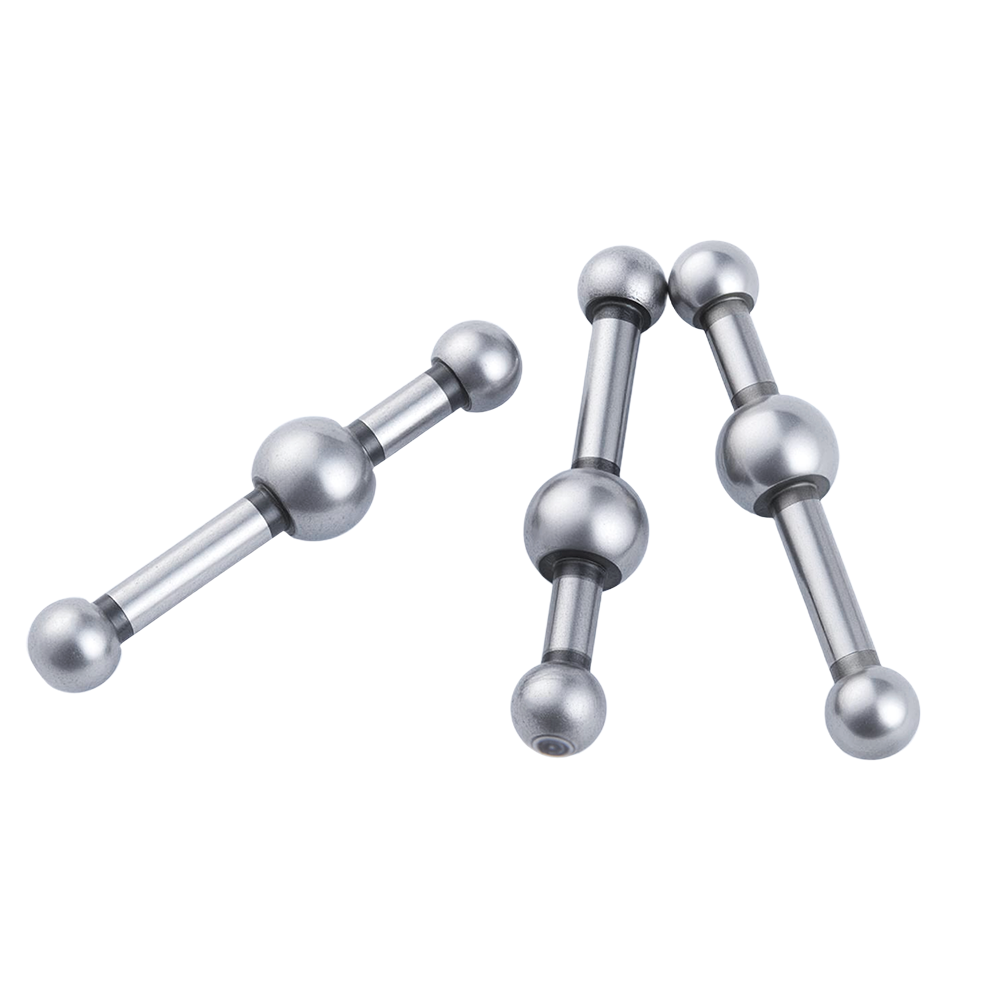 CNC Precision Machined Automotive Parts for OEM ApplicationsView turned automotive shafts, sleeves, pins, and valve parts for high-volume OEM programs where demanding tolerances and clear drawings matter.View Product →
Tolerances, Finishes, and What to Put on the Drawing
Vague drawings cost everybody time. Two or three extra numbers on the print usually prevent a round of emails and a possible rework.
Size and geometry
General dimensions can follow a standard such as ISO 2768-m, which keeps the drawing readable. Critical diameters deserve explicit limits: plus or minus 0.02 mm is a comfortable production tolerance, and plus or minus 0.01 mm is achievable on a well-controlled Swiss lathe, though it increases inspection effort and cost.
Surface finish
As-turned surfaces typically land around Ra 1.6 to 3.2 micrometres. Where a seal, bearing, or sliding fit is involved, Ra 0.8 is a sensible request, and ground surfaces can reach Ra 0.4 or better. Specifying a finer finish than the function needs simply adds cost.
Other details worth stating
- Material grade and condition, including whether it must be annealed, pre-hardened, or supplied in a specific temper.
- Heat treatment and any hardness range required after machining.
- Surface treatment such as passivation, zinc plating, or anodising, and which surfaces must be masked.
- Burr expectations, especially on internal bores and thread entries.
- Cleanliness requirements for parts destined for fluid or optical assemblies.
Where Steel Turned Parts End Up
The industries that buy turned parts are diverse, but the underlying need is consistent: a round component that must fit, seal, or rotate reliably, in volume, at a predictable price.
Liquid cooling and fluid handling
Cold plates, manifolds, and spray systems depend on nozzles, connectors, and fittings that do not leak. Internal bores and thread concentricity matter more here than raw dimensional precision, because a fraction of a millimetre of misalignment can change flow behaviour.
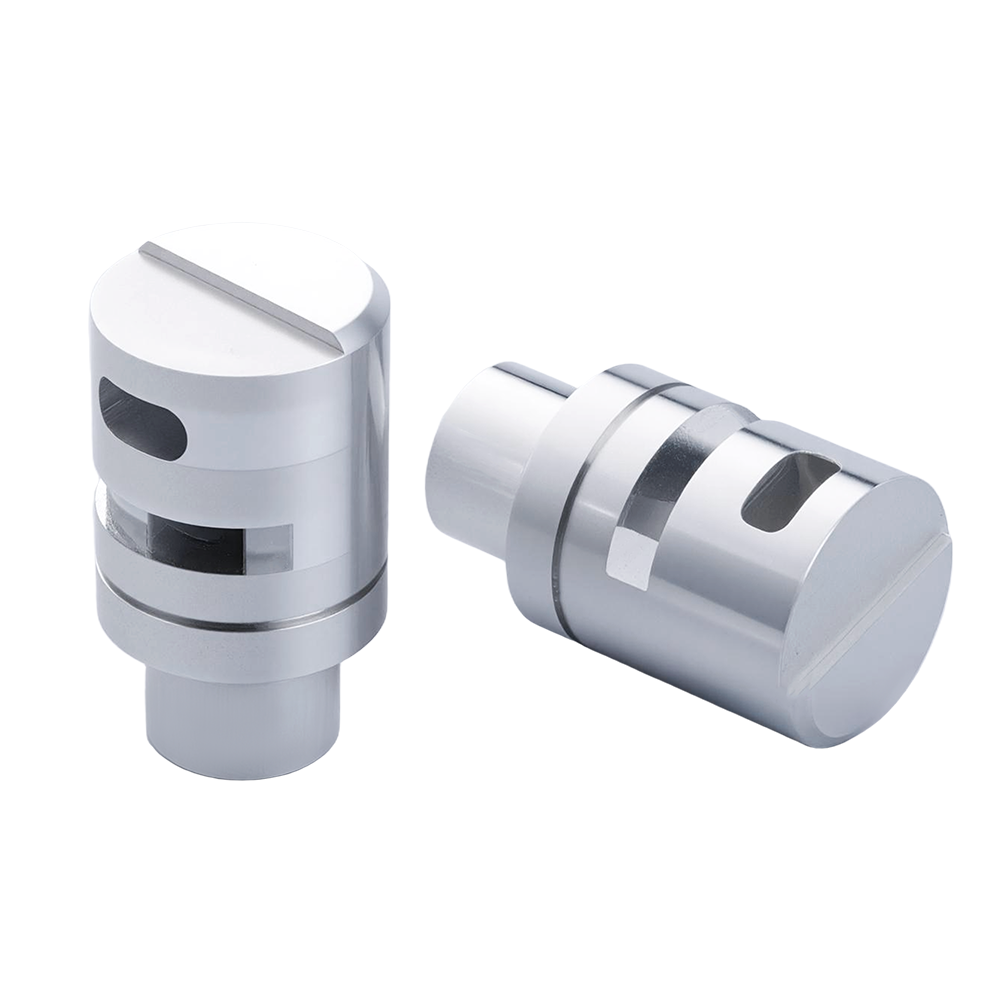 CNC Precision Machined Liquid Cooling PartsFor AI server and data center liquid cooling, these valve cores, nozzles, connectors, and fittings support leak-free fluid control and sealing.View Product →
Power tools
Drills, grinders, and impact drivers run hot and vibrate constantly. Their internal drive components need consistent hardness and geometry so that gear meshing stays quiet through thousands of cycles.
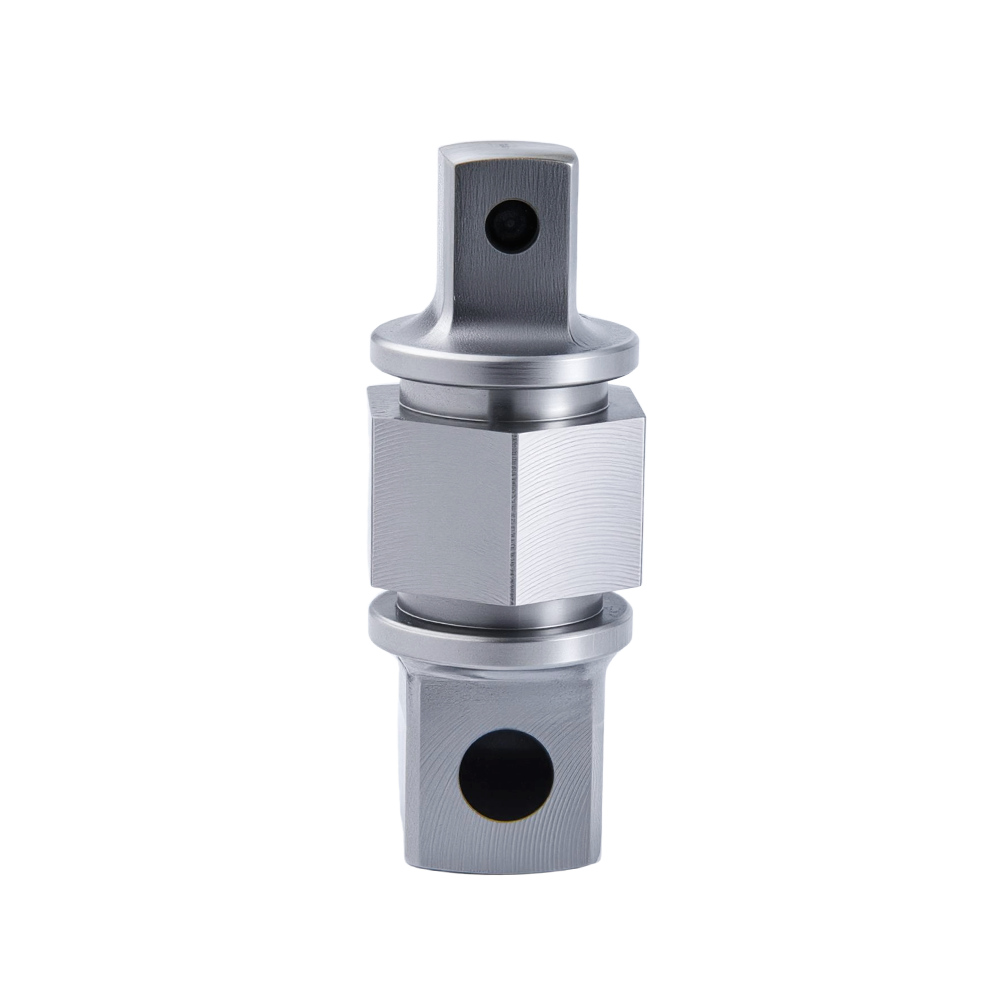 OEM CNC Precision Machined Power Tool PartsOEM transmission components, planetary gear shafts, motor shafts, and bearing rings for power tools that need stable hardness and quiet gear meshing.View Product →
Optical and instrumentation
Shims, spacers, and mounting components in optical assemblies are often tiny, and their thickness tolerance directly affects image quality. They are a good example of a turned part where the specification, not the shape, is the hard part.
Home appliances, medical devices, and general machinery
Appliance manufacturers need motor shafts and control knobs in large quantities. Medical work tends to arrive as smaller batches with tighter documentation. General machinery, from pumps to packaging lines, is the broadest category of all, and it is where many standard turned parts find a home.
Working From a Drawing: Practical Notes
Most turned part projects start with a customer drawing or a sample. A few design habits make the difference between a smooth run and a difficult one.
- Keep the length-to-diameter ratio reasonable where possible. Beyond roughly 10:1, slender parts need extra support and slower cycle times.
- Use standard thread pitches and drill sizes; special tooling adds lead time.
- Allow a sensible corner radius on internal shoulders so a tool can reach the feature cleanly.
- Place tolerances only where they are functionally needed, and let the rest follow a general standard.
- Mention the assembly context. Knowing that a bore will receive a press-fit pin changes how the machinist approaches the cut.
For a part that combines turning with milling or grinding, it helps to discuss the process route early. We often run Swiss turning for the primary geometry and then finish critical diameters with centreless or cylindrical grinding, which is a common route for slender steel shafts. You can see how we approach that combination on our Swiss-type turning capability page.
Quality Control on Turned Parts
Inspection is not a final step so much as a running one. In our workshop, first-article samples are measured before a run starts, in-process checks are taken at defined intervals, and final inspection confirms the features that carry tolerances. Measuring equipment matters as much as the machine tool: micrometers, bore gauges, profile projectors, and optical comparators catch different classes of error, and imported instruments from Japan and Germany form the backbone of our inspection room.
Material traceability is worth asking about. Mill certificates confirm the grade and heat number of the steel that went into the parts, and for stainless work, that paperwork often matters more to the customer's auditors than the dimensions do.
Choosing a Steel Turned Parts Supplier
The right partner is usually the one that answers technical questions quickly and honestly. When comparing suppliers, these points tend to separate the reliable ones from the rest:
- Which turning machines are actually on the floor, and whether sliding-headstock capability exists for slender parts.
- Whether secondary operations such as milling, grinding, and cleaning are handled in-house or outsourced.
- How first articles are documented, and whether inspection reports accompany shipments.
- Whether small trial batches are possible before committing to volume.
- How material certificates and heat treatment records are handled.
It also helps to visit. Walking through a workshop tells you more in twenty minutes than a catalogue will in an hour, which is why we welcome customers to our facility in Yuyao. If your project involves stainless steel components specifically, our stainless steel turned parts page covers the grades and finishes we handle most often.
Steel turned parts are simple in concept and demanding in execution. A short conversation about material, tolerance, and quantity at the beginning usually saves far more time than any amount of rework later. Send over a drawing or a sample, and we will tell you plainly what the part needs and what it will take to make it well.
-
CNC Precision Machined Automotive Parts: Materials, Tolerances, and How to Choose the Right Manufacturer
CNC precision machined automotive parts are components produced by computer-controlled subtractive manufacturing processes — turning, milling, drilling, grinding, and multi-axis machining — to dimensi...
-
How Do You Choose Precision CNC Machining Parts Based on Tolerances, Materials, and Supplier Capabilities?
A precision CNC machining part earns its name on the production floor, not in a brochure. The test is simple to state and hard to pass: does the part hold its specified dimension — often within ±0.01...
-
CNC Precision Machined Automotive Parts: Materials, Tolerances & Applications
Every confident start on a winter morning, every quiet stretch of highway, every smooth brake application depends on hundreds of small metal parts doing their jobs without complaint. That is the worl...
-
CNC Turning and Precision Metal Parts Manufacturing
CNC Turning and Precision Metal Parts Manufacturing Precision CNC machining is an essential process for manufacturing metal components used in a wide range of industrial applications. From aluminum pa...
-
CNC Precision Machined Liquid Cooling Parts: Tolerances, Materials, Sealing
A water block can pass every dimensional report and still drip on the test bench, because its O-ring groove came off the machine a few hundredths of a millimeter oversize. Situations like this are wh...
-
CNC Precision Machined Power Tool Parts | Swiss-Type Turning & OEM Custom
When a power tool design moves from prototype to production, the parts that typically cause trouble are the small rotary and housing components: motor shafts, transmission shafts, spline shafts, valv...

- Products
- CNC Precision Machined Automotive Parts
- CNC Precision Machined Liquid Cooling Parts
- CNC Precision Machined Power Tool Parts
- CNC Precision Machined Optical Components
- Customize
- Swiss Turning
- Machining Center
- CNC Milling&Turning
- Centerless Grinding Machine
- Cylindrical Grinding Machine
- Contact
-
-
TEL: +86-0574-62480516

-
E-mail: [email protected]

-
Phone: +86-13175199595

-
Address: Address: No. 6 Shiji 1st Road, Mazhu Doumen Development Zone, Yuyao City, Zhejiang Province, China

-

